
Carter County Parole and Probation
Parole is a conditional return to the community before a prison sentence expires. The Tennessee Board of Parole authorizes it for an eligible felony offender, while the Tennessee Department of Correction, or TDOC, completes release processing and provides field supervision. A favorable Board decision is not the same as the day the person leaves custody. A release plan must be approved, and any pre-release conditions must be met before physical release.
Probation is ordered by a court. It may start without a state-prison stay, or it may follow a period of split confinement. TDOC states that a person placed on probation, or released from split confinement, must report within 48 hours. Thus, a FOIL result marked probation does not by itself prove a prior prison release. Read it with the judgment and release details. The TDOC types of release page also distinguishes determinate release, mandatory reentry supervision, and Community Supervision for Life.
| Point | Parole | Probation |
|---|---|---|
| Who authorizes it | Tennessee Board of Parole | Sentencing court |
| Custody history | Follows a period of incarceration | May be imposed without state-prison custody |
| Best public check | FOIL status, release detail, and Board record | FOIL status and the court judgment |
| End point | Discharge or sentence expiration, if no further term applies | Completion or discharge under the sentence and court record |
- Parole
- Conditional community release before the full sentence expires.
- Probation
- Court-ordered supervision in the community, with stated terms.
- Discharge
- The official end of a custody or supervision obligation shown by the proper record.
- Absconder
- A person alleged to have stopped reporting or left supervision without authorization.
Check Carter County Supervision Status
The public name-based starting point is Tennessee's Felony Offender Information Lookup, or FOIL. It covers current and former Tennessee felony offenders. It is not a complete list of every person released from the Carter County Detention Center. A local misdemeanor case or a direct probation case may instead require the Carter County court judgment. When FOIL does contain the person, its status must be read with the sentence, release information, and any parole-hearing notation.
- Search FOIL by full name or TDOC identifier. Use another stable field when available so a common name does not produce a false match.
- Read the exact status. Parole or probation supports current community supervision. Incarcerated means the person is not released from TDOC custody.
- Open the detail and compare release information, sentence data, and parole-hearing status. Do not convert an eligibility date into an actual release date.
- Use the TDOC field-office directory to identify the Carter and Johnson Counties office. The directory routes a case by area but does not disclose a public caseload.
- For probation, obtain the judgment when the route into supervision matters. For parole, compare FOIL with the Board hearing record and TDOC release information.
- If the status is inactive, request the relevant TDOC or court record before describing the reason or date of discharge.
The distinction matters when a county record and FOIL seem to conflict. A blank county roster paired with an incarcerated FOIL status often points to transfer into state custody, not release into the community. A probation status confirms supervision but may arise from a direct sentence. For the full custody-event sequence and local release-record request, use the Carter County released-inmate search.
Carter County District 10 Office
Carter County has a local TDOC supervision route. The official field-office directory assigns Carter and Johnson Counties to District 10 in Elizabethton. This is useful after FOIL shows parole or probation because it identifies the office serving the area. It is not a public name search and does not reveal a person's reporting schedule, conditions, or private case notes.
TDOC District 10, Carter/Johnson Counties419 W. Elk Avenue, Suite 3
Elizabethton, TN 37643
Fax: 423-542-5039
Telephone: not published for this suboffice in the reviewed directory
No neighboring-office telephone should be substituted for the Carter/Johnson suboffice. Use the current directory to confirm routing. A fax number proves a contact channel, but it does not mean all record questions or case information may be handled by fax. FOIL remains the official public name-based check.
For a record that FOIL cannot explain, TDOC central and archived-records channels may hold the state offender file. The supervising office can confirm how its directory is organized, while the Board handles parole hearing and decision questions. Keeping these roles separate prevents a local office listing from being treated as proof that a named person is on supervision.
Note: The District 10 office listing identifies the service area, not a public roster of Carter County parolees or probationers.
Carter County Parole Hearing Checks
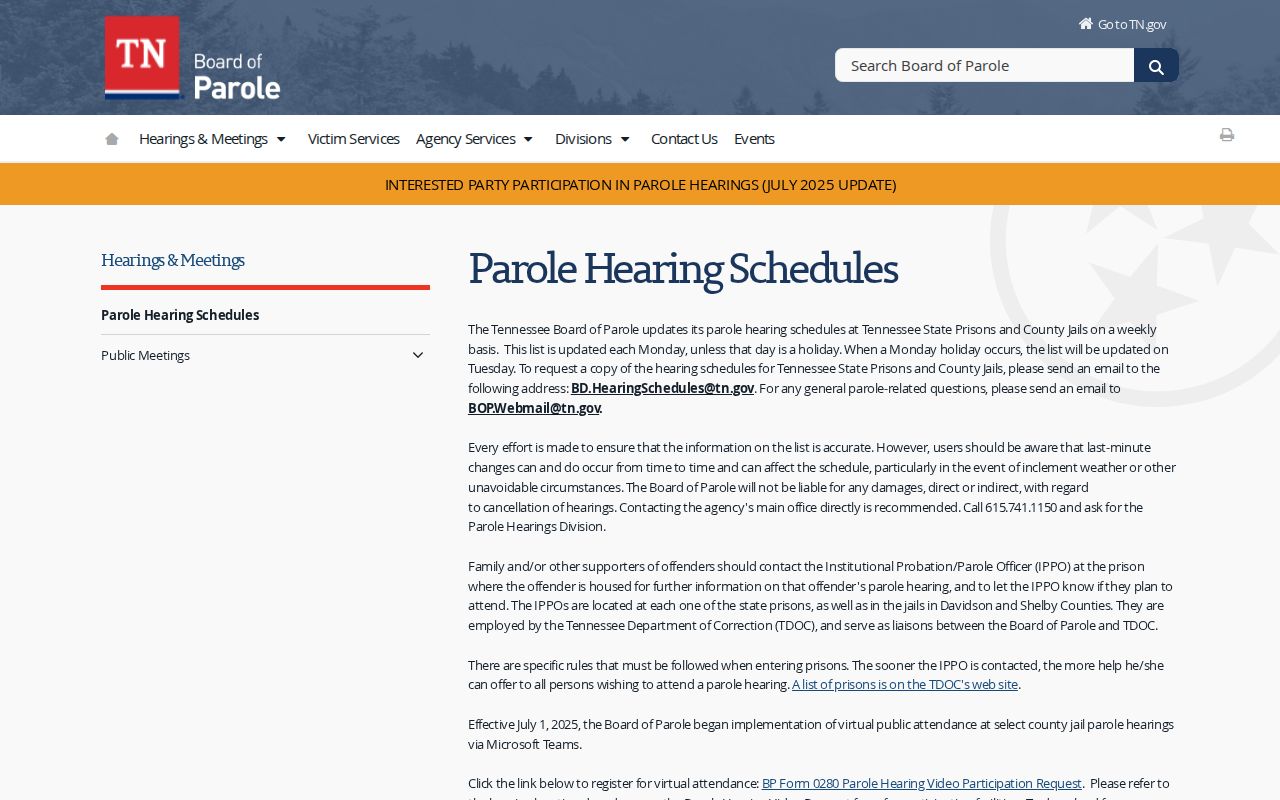
The Tennessee Board of Parole is an independent seven-member agency. Its current hearings page explains that state-prison and county-jail schedules are updated weekly, usually Monday or Tuesday after a Monday holiday. Current schedules are requested by email at BD.HearingSchedules@tn.gov. The older public schedule hub may still be available, but it should be checked against the Board's current instructions.
Legacy schedule fields include the TDOC ID, offender name, hearing type, scheduled date, and institution or hearing group. Initial parole and parole review are hearing types, not release results. Schedules can change. The Board publishes 615-741-1150 for verification, while the District 10 suboffice directory does not publish its own phone number.
The official schedule hub shows how Tennessee organizes hearing access.
That schedule evidence can establish that a hearing was planned, but only the later decision and completed TDOC release process establish the outcome and physical release.
Carter County Parole Decision Outcomes
A hearing officer finds facts and makes a recommendation. Board members may adopt, alter, or reject it. Tennessee requires three concurring votes for some matters, four for most violent convictions, and two to revoke parole. Official hearing categories include grant, preliminary revocation or probable cause, final revocation, custodial, pre-parole rescission, post-parole rescission, time setting, and appeal.
No current standalone statewide parole-decision search was confirmed in the Carter County research. The Board's decision and appeal information describes final labels such as denied, revoked, and rescinded, plus a 45-day appeal window on limited grounds. It is not a database of person-by-person outcomes. FOIL may show a person's parole-hearing status, while the Board can address its own official records.
A grant still does not mean the person walked out that day. TDOC calculates the release eligibility date under applicable law, checks the record, and must approve release processing. A release plan and any stated conditions remain between a Board vote and the completed custody event.
Note: Parole eligibility permits consideration by the Board; it is neither a promise of release nor the actual Carter County release date.
Carter County Supervision Violations
Conditions vary by judgment, release plan, and supervision type. At a high level, they can require reporting, compliance with lawful instructions, approved residence or travel, and other case-specific duties. Public sources should not be used to guess a private condition. The controlling documents are the judgment, Board action, TDOC record, and terms issued in the case.
An alleged violation is not the same as a completed revocation. An absconder designation ordinarily signals unresolved supervision and possible return to custody. Carter County has no official public absconder list identified in the research. Verify a claimed warrant through the court, TDOC or Board information, and the appropriate official warrant channel. FOIL may help identify active supervision, but it cannot replace the warrant or revocation record.
VINE can report custody movement, transfer, or release events from a reporting agency. It does not serve as a complete supervision record. If a person on parole returns to custody, compare the VINE event with FOIL and the Board's revocation process. The event, supervision status, and legal outcome may update on different schedules.
Carter County Supervision Discharge
Supervision ends through an official discharge, sentence expiration, or another case-specific action. FOIL may later show inactive status, but inactive does not define one universal event. It can indicate that TDOC no longer lists current incarceration, parole, or probation. Read the detail record and request archived material when the precise end date or legal basis matters.
Tennessee also uses forms of supervision that do not fit a simple parole-versus-probation choice. Determinate release can operate as probation for qualifying short felony sentences after the required service. Mandatory reentry supervision applies to specified felony sentences under Tennessee law. Community Supervision for Life begins after the imprisonment, probation, or parole period for covered offenses. Each status needs its own official record.
A Carter County court file may be essential for probation discharge because the court imposed the sentence. A state offender file is central for parole and TDOC supervision. Keep the end of county jail custody, the end of parole or probation, and the final expiration of a sentence as separate events unless the records show they coincide.
VINE may send a release or transfer alert near the start of community status, but it does not certify the later end of supervision. For that question, compare the final TDOC status with the court or Board record that controls the term. When FOIL changes to inactive, note the date checked and preserve the exact status label. An archived state record can then supply the specific discharge event if the public detail does not.