
Carter County Release Records Explained
A release from the Carter County Detention Center means that the Sheriff's Office no longer holds the person under that commitment. It does not always mean the person walked into the community. Bond, recognizance, time served, sentence completion, probation, dismissal, and a court order can lead to community release. A transfer can instead place the person with the Tennessee Department of Correction, another county, the U.S. Marshals Service, or an agency acting on a detainer. A detainer is a request or authority for another agency to take custody.
The official event should answer two questions: when did Carter County custody end, and what happened next? The public roster only describes current custody at the time shown. Once a name drops away, a booking and release record, VINE event, court docket, or receiving-agency result must supply the missing context. The Carter County Detention Center houses county, state, and federal inmates in one building. That mixed population makes the destination and receiving agency more important than the building alone.
| Release event | What it means | Best confirmation |
|---|---|---|
| Bond or recognizance | Pretrial custody ended while the charge may remain open. | Jail release entry, bond paper, and court docket |
| Dismissal or court order | The court changed or ended the custody basis in that matter. | Signed order, docket, and jail release log |
| Time served or completion | Credited confinement met the applicable sentence calculation. | Judgment, calculation, and actual release entry |
| Probation | Community supervision may follow a direct or split sentence. | Judgment and FOIL when TDOC supervises the case |
| Parole | Conditional community release began before sentence expiration. | FOIL, TDOC release record, and VINE event |
| Transfer or detainer pickup | County custody ended, but another authority received the person. | Destination field and receiving locator |
What Carter County Release Records Show
The Sheriff's public roster shows booking-side facts, not a released-inmate archive. Its details can include the booked name, photograph, booking date and time, inmate identifier, charge information, and physical descriptors. A person-specific VINE action is also available on active records. The reviewed interface does not publish a release date, release time, release type, destination, or 24-hour or 72-hour flag. Those facts belong in a request for the underlying record.
Ask for the record as maintained. Field names can vary, so a request should describe the event rather than claim that a named database column exists.
| Requested field | What it can establish |
|---|---|
| Booked name, aliases, and booking number | Connects the request to the correct commitment. |
| Booking date and committing agency | Identifies the start and source of county custody. |
| Charges and court numbers | Connects the jail event to the right docket. |
| Release date and time | Shows when the physical custody event was recorded. |
| Release disposition or reason | Distinguishes bond, completion, probation, transfer, or another outcome. |
| Destination or receiving agency | Shows whether the person entered another custodian's control. |
| Bond and surety information | Explains a pretrial release to the extent maintained and public. |
| Booking photograph | Links an image to the booking, not to current guilt or custody. |
A blank current roster is not a release record. It leaves release, transfer, correction, and update lag unresolved.
Request Carter County Release Records
Start with the CCSO Records Division request page and call 423-542-1852 to ask whether the jail, Records Division, or county coordinator holds the booking and release record. Records Clerk Kim Henegar can be reached at mcwherterk@sheriff.cc. The report-request page routes common police records, but it does not promise that every jail release log or historical photograph uses that same channel.
For a formal county request, the Carter County public-records portal identifies Heather Yates as coordinator. Inspection requests may be oral or written. Copy requests must be written on the county form and may be sent to the Carter County Finance Department, c/o Heather Yates, 801 E. Elk Avenue, Elizabethton, TN 37643, or yatesh@cartercountytn.gov. The coordinator's number is 423-547-4018.
- Give the full booked name, an approximate booking date, and the booking number when known.
- Ask for the booking and release record, release date and time, disposition, and destination if the event was a transfer.
- Request an electronic copy and an itemized estimate before costs pass a limit you choose.
- If material is withheld, ask for the statutory basis and all reasonably separable public portions.
- Match the result with the court docket or receiving system before describing the final outcome.
Tennessee's statewide reasonable-charge schedule permits up to $0.15 per standard black-and-white page and $0.50 per standard color page, plus qualifying labor and actual delivery or storage costs. Carter County published no special release-record or booking-photo fee in the reviewed sources. Inspection is ordinarily free unless another law authorizes a charge. Under the Tennessee Public Records Act response framework, when prompt production is not practical, the custodian has seven business days to produce, deny in writing with a legal basis, or provide a written explanation and reasonable estimate. That is not a promised delivery date.
The official CCSO records page shown here provides the local contact fallback.
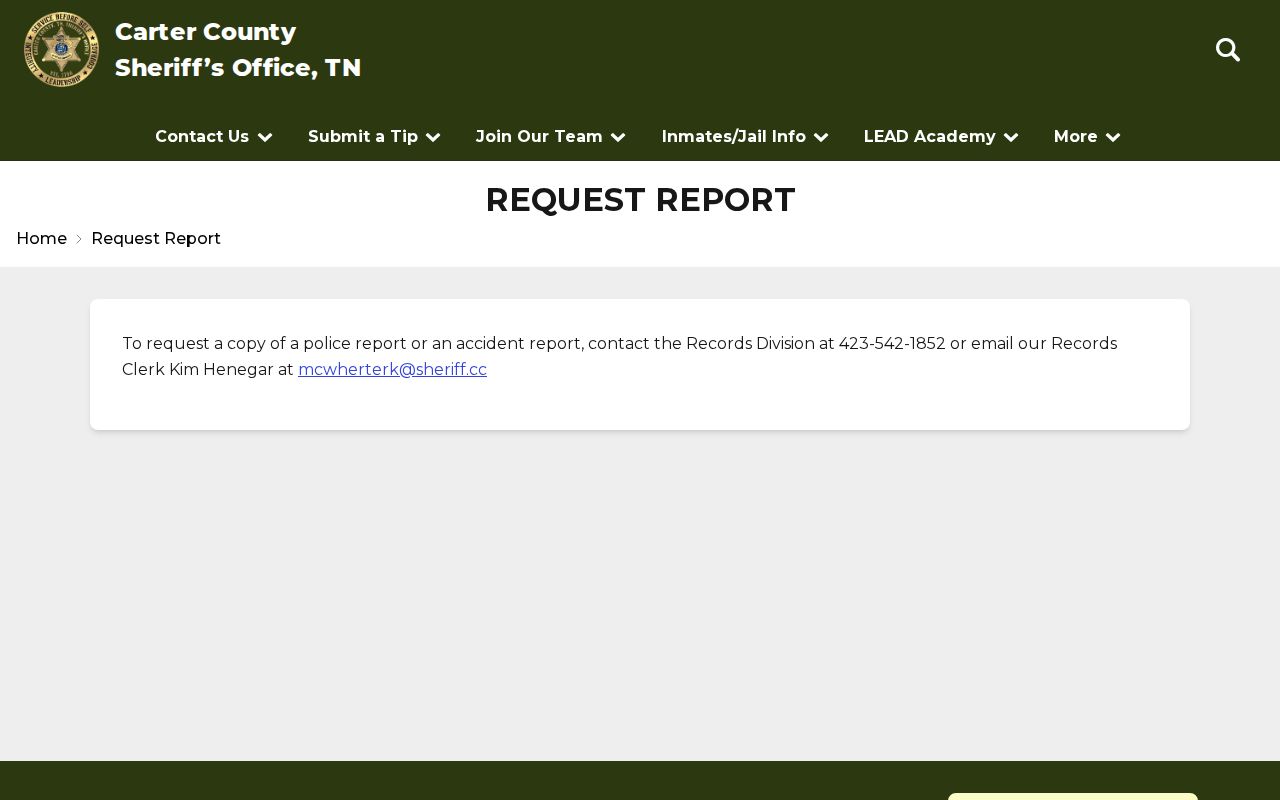
Use the contact information to confirm the correct custodian before submitting a detailed release-record request.
Carter County Release Record Law
Tenn. Code Ann. § 10-7-503 and related Tennessee Public Records Act provisions broadly cover records and photographs made or received in official business. A booking sheet, release entry, and booking photograph are recognizable record categories, but no record is automatically open in every case. Juvenile rules, expunction orders, sealing, safety redactions, and other specific exemptions can limit access. Tennessee's statutory inspection right applies to Tennessee citizens, and an agency may ask for government identification to establish citizenship.
Website display and legal retention are separate. Carter County's roster is a current list, and no local release-record retention term was confirmed. A vanished detail page does not show that the underlying record was destroyed. The Office of Open Records Counsel retention guidance points local agencies toward their adopted schedules. Ask the custodian which series applies and whether an older record remains available.
- Discharge
- The end of a custodial or supervision status under the controlling record.
- Time served
- A sentence outcome that credits confinement already completed.
- Detainer
- Authority or a request for another agency to assume custody.
- Expunction
- A court process that removes qualifying records from ordinary official access.
Is Carter Jail Population Release Data?
No. TDOC's July 2025 month-end jail report recorded Carter County with 111 inmates against 170 beds, a 65.3% snapshot. It also listed 27 TDOC backup inmates and eight local felons. Those figures describe one reporting date and illustrate that several custody types can share the detention center. They are not annual bookings, annual releases, turnover, or average length of stay.
No sourced annual Carter County release total was found. Treating the snapshot as flow data would erase the difference between a person held for the county and someone awaiting a TDOC move. The useful lesson is narrower: the system that confirms release depends on custody authority and destination.
Which Carter Court Proves Release?
Release proof may cross two Carter County court stages. General Sessions records can supply misdemeanor dispositions and early felony or bond events. Once a felony is indicted, the signed judgment belongs in First Judicial District Criminal Court. The jail roster names charges but does not supply the lasting case disposition or the legal reason for release.
Use the Tennessee AOC Carter County clerk directory to identify the correct clerk. Ask for the docket and signed order, then reconcile those papers with the jail release event. A bond release can coexist with an open charge. Likewise, a dismissal or time-served order may precede physical release if another hold remains or processing is incomplete.
Can VINE say released while a case stays open? Yes. VINE reports a custody event from a participating agency. The court docket answers the separate question of what happened to the prosecution.
Can Carter Release Records Disappear?
Tennessee Courts identifies certain arrests followed by release without charge as eligible for free expunction. Free paths also include qualifying dismissals, no true bills, acquittals, and nolle prosequi outcomes. An expunction can change normal access to official records. Conviction expunction is narrower and depends on the current statute and the case facts.
An old search result or image and a current official no-result are not necessarily inconsistent. Cached material may outlast a court change, while a custodian must follow the current order. The Tennessee Courts expunction eligibility resource gives the official starting point. A lawyer or the court clerk should address case-specific eligibility.
Search Carter County Released Inmates
The strongest lookup follows custody, legal authority, and after-status in sequence. It begins with the sheriff because the detention center is the only active local jail identified. It then shifts to the system that matches the outcome. No official 24-hour, 72-hour, or recent-release feed was found, so a name search cannot stop at a missing roster entry.
- Search the CCSO current inmate roster. A listed person is shown in present county custody, not released.
- If absent, search the exact person in Tennessee VINE and identify the reporting agency and event.
- Search TDOC FOIL when the charge or destination points to state felony custody, parole, or probation.
- Get the General Sessions or Criminal Court docket and signed order to establish the legal basis.
- Use BOP, ICE, or the federal court and U.S. Marshals route only when the commitment points to federal or immigration authority.
- Request the CCSO release or transfer record when online sources do not identify the date, reason, or destination.
The Carter County 24-hour release process narrows this method to same-day events. A named-person search still needs the full sequence because a transfer can look like a release when viewed only through the roster.
Record when each source was checked. A roster, VINE event, or receiving locator may update on a different schedule.
TDOC Search for Carter Releases
The Tennessee Department of Correction's Felony Offender Information Lookup, known as FOIL, covers current and former Tennessee felony offenders. It does not cover every Carter County booking. Search results can identify incarceration, parole, probation, or inactive status and may provide sentence or release information. An inactive label is useful evidence that TDOC does not list active incarceration or supervision, but it does not name one universal event behind that status.
The direct FOIL search supports several paths.
| FOIL field | Use | Matching caution |
|---|---|---|
| Last and first name | Basic person search | Compare identifiers before selecting a result |
| Alias | Find a recorded alternate name | Spelling and name order may differ |
| Race | Narrow a name search | Never treat it as a unique identifier |
| TDOC ID | Direct state-offender match | Best when copied from an official record |
| State ID | Alternate identifier route | Confirm that the source refers to Tennessee |
The official TDOC FOIL overview shown below defines the system's state-felony coverage.
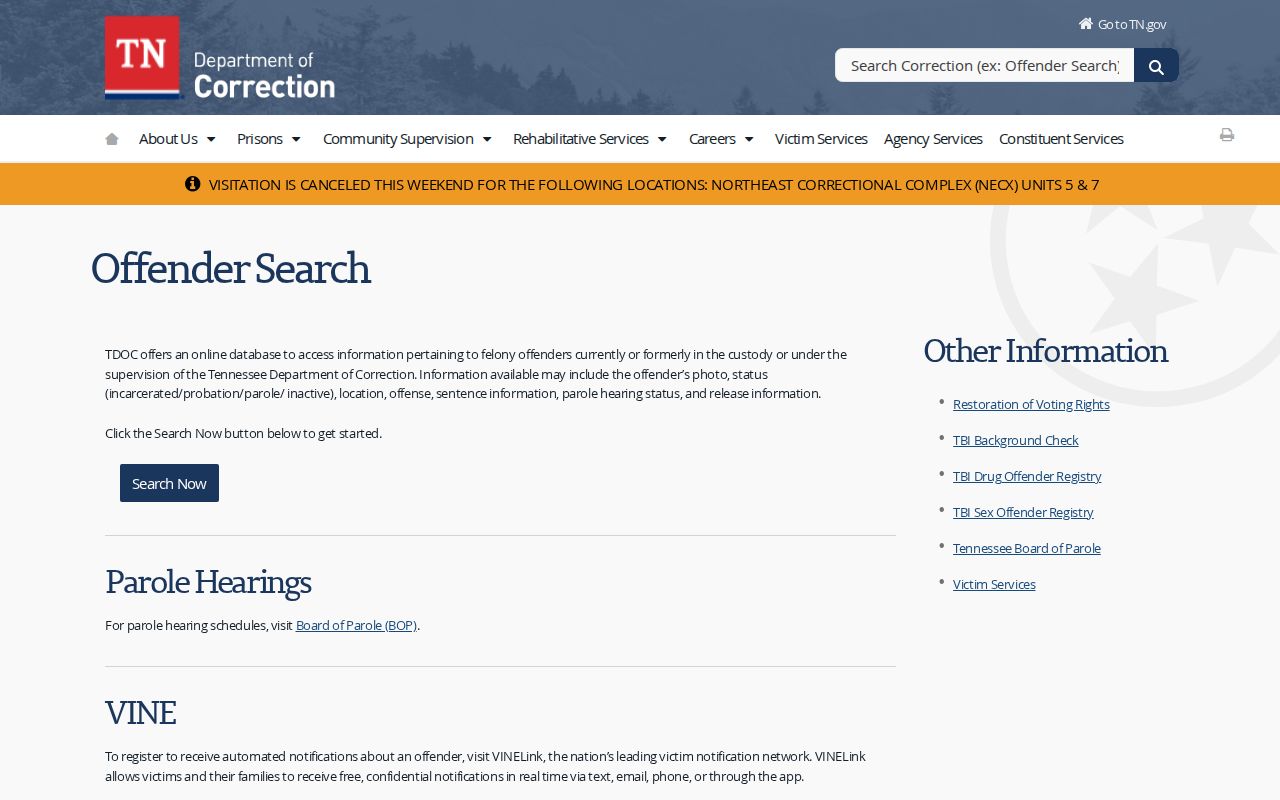
FOIL should be paired with the Carter County transfer record when the local roster is blank but the state result still says incarcerated.
Why Carter Releases Leave the Roster
The Sheriff's official sitemap exposes an inmate-roster route but no released-inmate archive or recent-release endpoint. Current records show booking facts, photographs, charge links, and person-specific VINE links. They do not show a release field. Removal from the live display is therefore a change in what the current roster shows, not a complete account of the person's destination.
A VINE release alert can help identify a custody change. A CCSO release record can give the local disposition and time. The court can explain the order, while FOIL or another locator can show later custody. These sources complement one another. None should be stretched beyond the reporting agency and commitment it identifies.
Carter County Post-Release Status
Parole is conditional release from incarceration before sentence expiration. Probation is community supervision ordered by a court and may begin without a state-prison stay. FOIL is the public name-based way to verify covered TDOC status. The District 10 Carter and Johnson County office serves local supervision, while the Tennessee Board of Parole handles parole decisions. A district-office listing is not a public person lookup and should not be used to infer a private reporting schedule.
A FOIL parole status supports a prior move into supervised community release. Probation alone does not prove release from state prison because it can follow a direct sentence or split confinement. The judgment and release information complete that distinction. Carter County post-release supervision must be verified through FOIL and the controlling judgment.
Carter Release Alerts and Federal Records
Carter County participates in Tennessee SAVIN/VINE, and active roster records link directly to a person-specific notification action. VINE can report moved, transferred, or released events from participating county and TDOC sources. Match the person and reporting agency, then confirm the disposition with that agency or the court. A VINE release does not prove that no other agency holds the person.
Federal paths are separate. The BOP Inmate Locator covers federal Bureau of Prisons sentences and may show a release date or that a person is not in BOP custody. That statement is BOP-specific, and federal supervision or another custodian may continue. ICE's Online Detainee Locator generally covers people currently detained and some people released within the prior 60 days. A no-result can reflect timing, suppression, incomplete identifiers, or no ICE history. U.S. Marshals pretrial or transport custody is checked through the relevant federal court or district because USMS has no general public released-prisoner list like FOIL.
Where Carter Released Inmates Appear
Choose the source by custodian and event. The same person can move through several systems without experiencing a community release.
| Source | What it covers | How to read absence or release |
|---|---|---|
| CCSO roster | Current Carter County Detention Center custody | Absence is unresolved until another record explains it |
| CCSO release record | End of a Carter jail commitment | Use disposition and destination to distinguish release from transfer |
| VINE | Participating agency custody events | Verify the reporting agency and event type |
| TDOC FOIL | Current and former Tennessee felony offenders | Read status and detail fields; it is not every county booking |
| Carter courts | Bond, disposition, and judgment authority | An order and physical release are related but distinct |
| BOP or ICE | Agency-specific federal or immigration custody | No result does not clear all other custodians |
Is the Roan Mountain Annex Open?
No. Older government contracts and directories may still identify the Northeast Correctional Complex Carter County Annex at 188 Old Railroad Grade Road in Roan Mountain. Tennessee's fiscal year 2021-22 budget records its closure and the move of prisoners and staff into vacancies at the main Northeast Correctional Complex. A stale directory entry is not proof of current custody or a recent release.
Search statewide FOIL for a person once held at the annex, then request TDOC archived records if the public result does not settle the historical event. The closed Carter County Annex record must remain distinct from the active county detention center.
Carter County Release Facilities
Two facility records matter, but only one is active in Carter County. The building and custodian determine the first search route.
- Carter County Detention Center: active CCSO county jail; confirm exits through the jail record, VINE, court, and receiving system.
- Northeast Correctional Complex Carter County Annex: closed historical TDOC annex; use FOIL and TDOC archived records.
No active municipal jail, TDOC prison, federal prison, or ICE detention center located in Carter County was established in the official material reviewed. The active detention center can house people for several authorities, but that does not change its status into a state or federal prison.