
Carter County Booking Photo Records
A booking photograph records the person's appearance when an agency processed an arrest or commitment. Tennessee's public-record definition can include photographs made or received in official business. That makes a Carter County booking photo a recognizable record category, but it is not automatically available in every case. The custodian must still apply lawful exemptions, juvenile confidentiality, redaction rules, and any sealing or expunction order.
Release does not change what the image proves. It remains tied to the earlier booking, not to the final result of the charge. The photo does not show whether the person bonded out, completed a sentence, transferred to another authority, entered supervision, or obtained a dismissal. Pair it with the release record and court disposition. That context prevents an old arrest image from being mistaken for current status.
The source-discovery approach also preserves dignity and accuracy. Carter County's official systems should be checked before any copied image. A current response from the custodian carries more weight than an old cached copy, especially when an expunction or correction may have changed public access.
Find Carter County Release Mugshots
No official Carter County released-photo gallery was found. Each available channel has a narrower scope. The Carter County Sheriff's Office roster shows current inmates and booking photos. A records request is the chief route for a historical local image. Tennessee FOIL may include an offender photo for a current or former TDOC felony offender, but it does not cover every county booking.
| Official or documented channel | Has a photo? | How to use it |
|---|---|---|
| CCSO active roster and detail | Yes, for current records | Search the live roster while the person remains listed; it is not a release archive. |
| CCSO official OCV app | Variable and unconfirmed | Use it as an official access point, then verify against the web roster or records custodian. |
| CCSO or Carter County request | Requestable record category | Ask for the specific booking photo together with the booking and release record. |
| TDOC FOIL | May include an offender image | Use for a person within current or former Tennessee felony-offender coverage. |
| CCSO press release | Sometimes | Treat it as selective incident coverage, not a complete photo or release index. |
| News or copied third-party page | Sometimes | Use only as a lead, with no assumption that the image or case status is current. |
VINELink may help track a custody change, but Carter County research does not establish it as a historical photo archive. Likewise, a press image can identify the incident it accompanied without proving release. The underlying official booking, release, and court records remain the sound comparison set.
The sheriff's live roster illustrates the present-custody photo channel.
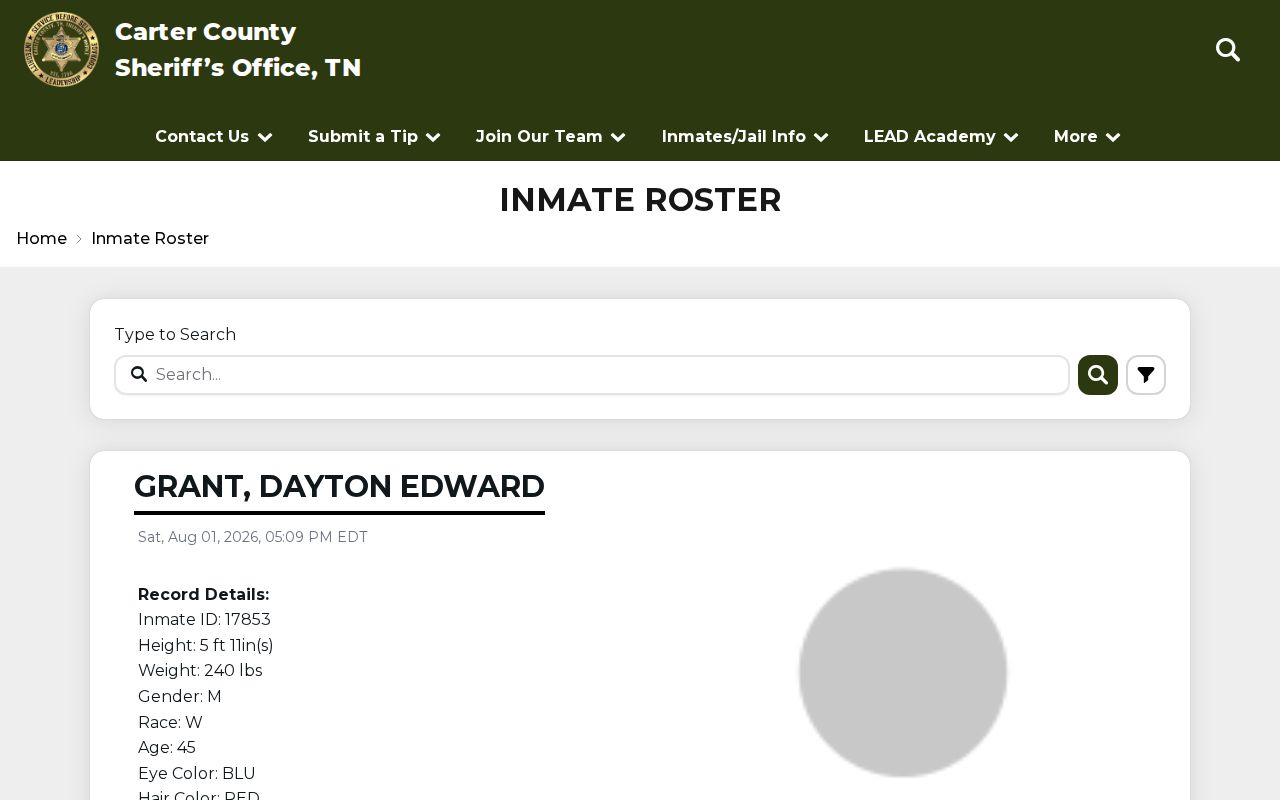
Once a name leaves that screen, the image is no longer a public web-based confirmation of the person's destination or release event.
Carter County Mugshots: Current History
The most distinctive Carter County photo rule is practical rather than statutory: photos are visible for current custody, while history is request-based. The sheriff's sitemap exposes an inmate-roster route but no released-inmate, recent-release, 24-hour, or 72-hour archive. Reviewed detail records show the booking date, identifying traits, charges, and a booking photograph. They do not show a release date, release type, destination, or historical photo index.
A dropped name creates an open question. The person may have entered the community, transferred to TDOC or another jail, left on a court order, or moved because another agency took custody. Save the identifying details needed for a careful match while the current record is visible, but do not republish a gallery. After the record drops, use its VINE link for a custody event and ask the custodian for the official release disposition.
Legal retention is not the same as online display. The Tennessee open-records retention hub points local agencies to applicable schedules, yet no precise Carter County term for release-photo web display was found. An image may leave the site while the underlying record still exists. Ask the custodian which record series applies.
Note: A Carter County booking photograph establishes a recorded image at booking, not release, conviction, or present custody.
Request Carter County Booking Photos
The best route to an older Carter County image is a narrow request for the booking photograph and its matching release record. This pairs the image with the custody event. The sheriff lists a Records Division line at 423-542-1852 and Records Clerk email at mcwherterk@sheriff.cc. That contact can help identify whether CCSO, the jail, or Carter County's public-records coordinator keeps the exact record.
- Identify the person with a full booked name, approximate booking date, and booking number if known. Add a date of birth only when needed to distinguish the record.
- Call the CCSO Records Division first. Ask which custodian maintains the historical booking photo and jail release record.
- For copies, use the written county form available through the Carter County public-records portal. Send it to the custodian the county or sheriff identifies.
- Request the booking photo, booking date and time, release date and time, release disposition, and destination or receiving agency if the event was a transfer.
- Ask for electronic copies and an itemized estimate. If a part is withheld, request the statutory basis and all reasonably separable public portions.
Carter County names Heather Yates as Public Records Request Coordinator at 801 E. Elk Avenue, Elizabethton, TN 37643, 423-547-4018, yatesh@cartercountytn.gov. Inspection requests may be oral or written; copy requests must be written on the county form. Call first because the generic sheriff report-request route does not promise that every jail photograph or release log is delivered by the same office.
Under the Tennessee Public Records Act response framework, a custodian should promptly produce a readily available record. If prompt production is not practicable, the office has seven business days to make it available, deny it in writing with the legal basis, or explain the delay and provide a reasonable estimate. No special Carter County release-photo fee was found. Statewide guidance allows certain copy, labor, and delivery costs, so seek an estimate instead of assuming the request is free.
Carter County Sheriff Photo App
CCSO launched its official OCV app in 2025. The public listing describes sheriff information, tips, and news. It does not promise a release list, released-photo archive, or even a fixed set of inmate-photo features. One public review reported that inmate photographs disappeared at one point, while the current website displays photos. That mismatch supports only a modest finding: app features can change.
The official Carter County Sheriff app landing page is a useful source for the current download route. It should not displace the roster or records custodian. If the app shows a photo, compare the name and booking detail with the web record. If it does not, that absence is not proof the agency lacks a booking image.
The official app landing page documents this supplemental Carter County access channel.
The screen is evidence of an agency app, not a promise that a released person's photo or release record will remain available there.
Carter County Release Photos Beyond CCSO
A person transferred from Carter County to Tennessee felony custody follows a different photo path. Search the TDOC FOIL system by name or offender identifier. FOIL may include a photo for current or former TDOC offenders. Label that image as a TDOC offender-record photo unless an official source confirms it is the same image made during the Carter County booking.
CCSO press releases and local news sometimes publish incident images. Coverage is selective. It is not a name-complete jail index, and a story date does not establish a release date. A copied commercial or third-party page can persist after the official record changes, lose the disposition, or join the wrong facts to a common name. No commercial mugshot publisher, broker, or removal service is linked or endorsed.
For a person released from federal custody, a local Carter County booking image may have no role at all. Use the federal agency's custody record for release status. The building where someone was held does not determine which agency made a photo or owns the release record. Source, agency, and record type should stay attached to each image.
The Carter County 24-Hour Releases page explains why the sheriff's live roster cannot be converted into a recent-release feed. That same limit prevents it from serving as a released-photo gallery.
Carter County Mugshots After Expunction
Tennessee Courts identifies several outcomes that may qualify for free expunction. They include certain arrests followed by release without charge, dismissal, no true bill, acquittal, and nolle prosequi. Conviction expunction is narrower and depends on current law, the offense, criminal history, sentence completion, and any waiting requirement. A jail release alone does not mean the record qualifies.
An expunction can change what the court and law-enforcement systems disclose through ordinary access. A current official no-result and an older image are therefore not necessarily inconsistent. The clerk and record custodian apply the order to the systems they control. Ask the Tennessee Courts expungement source and the proper Carter County clerk about the official process rather than relying on a copied photo.
An image held by a news outlet or another private publisher is a separate correction or removal matter. A requester can provide the final court order and ask the publisher to apply its policy, but no result should be promised. No enacted Tennessee-specific pay-to-remove mugshot statute was found in the official-source review. That narrow finding does not rule out an expunction order, a correction claim, other generally applicable law, or a voluntary publisher policy.
Verify Carter County Mugshot Context
Photo discovery is only the first step. A sound match uses the booked name, booking number, booking date, charge or case number, and another stable identifier. Then the Carter County release record supplies when local custody ended and whether the event was bond, court order, time served, transfer, or another coded disposition. The court docket explains what happened to the charge.
If the roster is blank but FOIL says incarcerated, describe the event as release from Carter County custody and transfer to TDOC when the records support it. If VINE says released while the case remains open, bond or recognizance may have ended the jail stay without ending prosecution. If a court says dismissed but the person remains listed, another hold or processing delay may explain the difference. A photograph resolves none of those conflicts.
When no online source supplies the answer, move to the record custodian. Ask for the booking photo and release fields in one request, then obtain the relevant General Sessions or Criminal Court order. The Carter County released-inmate lookup sets out that full source sequence. Official records can still be incomplete or subject to lawful restrictions, so record the source and date checked with every conclusion.